 Skip Navigation


Are dimples genetically inherited?
February 19, 2026
- Related Topics:
- Genetic myths,
- Appearance,
- Complex traits
A woman from India asks:
"I have dimples, but none of my parents nor any one in the long history of all generations has it as far as I can see. I read some articles saying it is not genetically possible? I am afraid please answer."
Fear not! Genetics isn’t the only factor behind dimples, although genes do play a role. You can absolutely have dimples even though none of your ancestors do.
Across many cultures, dimples, or indentations in the skin, are prized for their beauty and uniqueness. Dimples can vary in size and depth and appear on different parts of the body, including the cheeks, chin, back, and limbs. For this article, I will focus on the most common type of dimples, cheek dimples.

How do dimples form?
These quirky indentations are caused by an abnormality in the zygomaticus major muscle, a muscle that controls facial expressions. In some people, a portion of this muscle is attached to the overlying skin, rather than other muscles.1 This muscle-to-skin attachment creates an infold in the skin, which becomes more obvious when someone smiles. Think of it like a rope tether!
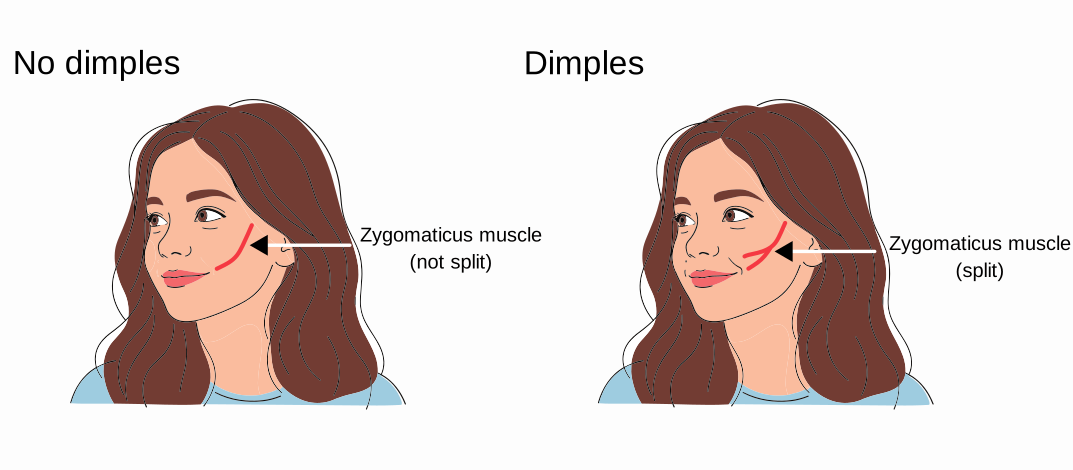
However, some dimples can arise due to unique situations. Certain dermatological conditions, including cancer and scars, can also produce a dimple. In rare cases, infections in the teeth and gums lead to a temporary dimple that disappears once the infection is gone.2
To summarize, dimples can arise from differences in facial muscles or certain medical conditions.
Is there a genetic basis for dimples?
There are many misconceptions surrounding dimple inheritance, with some sources claiming the dimple gene is located on chromosome 5. However, the body of literature regarding dimple inheritance isn’t particularly strong. Perhaps not too surprisingly, the majority of recent publications focus instead on cosmetic strategies to create dimples. Most of what we know comes from observing patterns in large groups of people or studying a few individual cases, not from experiments that show exactly how dimples form.
So, what does the literature say about inheriting dimples?
Dimples are relatively common and do run in families. There are documented cases in which related individuals have dimples with the same location and depth.3
In the field of genetics, identical twin studies are valuable because these individuals have (mostly!) the exact same DNA as each other. This means if a trait is inherited, both twins should have it.

One study investigated a cohort of 150 identical twins. Of the 8 pairs of twins that had dimples, 5 pairs had dimples of the exact same shape and depth.4 This suggests that dimples can be inherited. However, because the study sample is small, the results could have arisen due to random chance. We can’t say definitively that there is a strong association between being genetically identical and having identical dimples.
While studies with larger cohorts are needed to have more certainty, the literature does suggest there is a genetic component to dimples.
Is there a singular dimple gene?
According to one study about inheritance patterns in Kyrgyz populations, dimples seemed to be inherited based on one gene, with just two versions of that gene.5 However, the dimple gene has not been identified or connected to an abnormality in the facial muscle. The story is much more complicated.
In fact, there are over 24 genes that play a role in the development of our facial shape.6 Some of these are common across populations, while others are unique to certain ethnic groups. All these genes that influence our facial features might explain the variability we observe in dimples, including the number, location, size, and depth.
Having a dimple gene doesn’t guarantee you’ll have dimples. Rather, it might be that having the dimple gene makes you more likely to have dimples. What the dimple looks like may depend on a variety of genes, not just one.
Dimples are a dynamic feature
There is another interesting factor to consider beyond muscle structure and genetics. Dimples aren’t always a permanent feature. A person can be born with a dimple, but lose it as they age. On the other hand, a person can gain dimples later in life.
One explanation for why people appear to outgrow their dimples is related to facial fat. Some suggest that having more fat helps create folds or dimples. This may explain the higher prevalence of dimples in women than men4,7 and in infants than adults.3 Since men and older people tend to have less facial fat, their dimples might not show up as clearly. In other words, you might still have dimples, but you can’t always see them in the mirror.
There are additional studies supporting the idea that facial fat can play a role in dimple formation.8 However, it’s important to note that facial traits particular to ethnic groups may also affect dimples.
Regardless of how it happens, dimples are dynamic and aren’t an exclusively genetic feature.
We still don’t entirely understand why some people have or don’t have dimples. Even with growing interest in methods for creating cosmetic dimples, it’s important to investigate the underlying mechanisms behind natural dimple formation. Even though we know some things about how dimples form, there’s still a lot to learn about facial anatomy and the medical conditions that affect dimples. Asking these kinds of questions is how science moves forward!
Rest assured, genetics are not the only factor at play in having dimples. Dimples are a wonderful feature. All the more reason to keep smiling!


Author: Katie Fang
When this answer was published in 2026, Katie was a Ph.D. candidate in the Stanford Immunology Interdepartmental Program, studying a tumor reprogramming cancer vaccination approach in Ravindra Majeti’s laboratory. Katie wrote this answer while participating in the Stanford at The Tech program.