 Skip Navigation


How can someone be a very different height from their parents?
March 5, 2026
- Related Topics:
- Height,
- DNA basics,
- Complex traits
A curious adult from New Jersey asks:
"My husband and I are exactly the same height 5'1". We both come from families with an average height of 5' 1" to 5" 2". However our daughter (currently 18) is 6'8". Is there a mutant gene similar to the one for redheads that can cause such a height difference? Or is our dr correct it's all just a roll of the dice?"
Doctors may call extreme height differences like this a roll of the genetic dice, however you may be surprised to find that height is not as random as you may think. The genetics behind height is complex and fascinating, involving multiple genes for one single trait. We know environmental factors influence height, including nutrition, health during childhood, and hormones. However, geneticists have estimated that 80-90% of height variation is due to passed down genetic factors.
Height is Polygenic
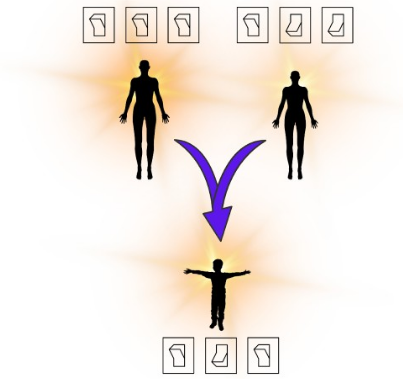
Many traits in our DNA are controlled not by a single gene, but thousands of genes working together in tandem. Height is one of the most classic examples of these kinds of traits, also known as a polygenic trait. In contrast, Mendelian traits are typically influenced by a single gene variant. A gene variant is a difference in the DNA sequence of a gene that can affect how that gene functions. Unlike these single-gene traits, height results from the cumulative effects of many small genetic differences acting together.
We can think about height like an adjustable light. Instead of a single light switch, your DNA contains a multitude of switches that dim or brighten that light. So while your parents may be 5’ 1’” and 5’ 2”, they are passing down multiple light switches to their child. Some add a millimeter and some subtract two millimeters and adding all of them up can result in a 6’ 8” child which looks vastly different from their parents.
GWAS and the Many Height Genes
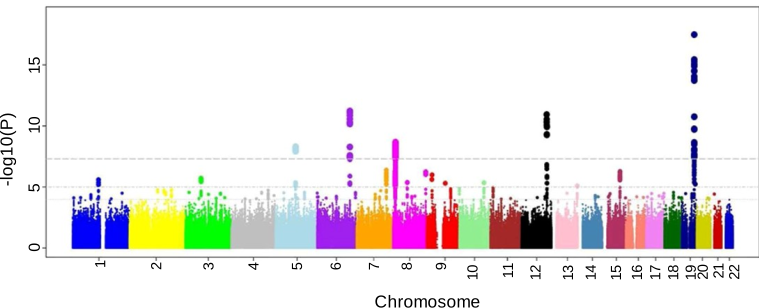
While the exact genetics behind height remains mostly a mystery, we have identified a few of the genes associated with height. Geneticists have used a method called Genome-Wide Association Studies (GWAS) to find variants associated with a particular trait. Rather than looking at a single gene, GWAS scans the entire human DNA sequence to see which variants are statistically linked with height differences. Luckily, height is one of the most studied human traits using GWAS, and we have discovered thousands of genetic variants that are associated with height.
Inheritance
We now know there are many genes involved with being tall, and this can help us explain why two short parents can still have a tall child. Each parent gives a child half of their DNA, and each parent carries many genetic variants. Some variants are common while some are rare, and the unique combination of variants passed down to your child results in the genetic “lottery” that doctors refer to. However, while height seems random, it is actually a big shuffle of many small genetic effects.
Specific Height Genes
There are a few known genes with a strong influence on growth plates. In all people, growth plates are the way bones grow, and genes that affect the activity of growth plates can result in taller or shorter stature. One gene, HMGA2,1 is responsible for the growth of bone and cartilage during development. Another gene, GDF5,2 is also involved in growth, development, and the maintenance of bone and cartilage. Variations in these genes cause tall height in some people or can lead to shorter height in others.
Is Height a Dice Roll?
Simply, yes the genetic outcome of height may feel a lot like luck, but it really is complex genetics at play. Height is a polygenic trait with multiple genes with small effects working together. That is why a daughter could be much taller than her parents. Plausibly, she inherited a rare, but genetically passed down, combination of height-boosting variants. You can think of it like rolling thousands of dice at once with each die representing a genetic variant. The overall result depends on how all these dice come together. It might feel like chance, but it is really the sum of many inherited genetic effects working in tandem, not pure randomness.

Read More:
- Further reading on height: Height Genes: Do They Come from Mother or Father?
- Hair color is another polygenic trait: Can we predict hair color in babies?
- Eye color is another polygenic trait: Is eye color determined by genetics?
- For a more technical understanding: Genetic prediction of complex traits with polygenic scores: A statistical review

Author: Samantha Tsai
When this article was written in 2026, Samantha Tsai was a Genetic Counseling master’s student interested in genetics patient care. Samantha wrote this answer while participating in the Stanford at the Tech program.