 Skip Navigation


Do bigger genomes mean more editing opportunities?
June 9, 2026
- Related Topics:
- Genetic engineering,
- CRISPR,
- Plant biology
A curious guest at The Tech Interactive asks:
"If an organism, like a strawberry, has a very large genome, does that mean there are more opportunities for us to modify its genome in cool/helpful ways?"
A larger genome does not automatically give scientists more useful ways to edit an organism. In many ways, it may actually make the process of genome editing more difficult. This is because a “larger” genome in plants is often created through the duplication of segments, chromosomes, or the entirety of the genome. With the result being more repeated sequences, more copies of similar genes, and more work overall required to sift through. Thus, in an organism like a strawberry, while a large genome provides scientists more genetic material to work with, it also creates more challenges.
TLDR: Not really.
More DNA is not the same as more opportunity
It is easy to see why someone might think a larger genome would be easier to work with as more material sounds like it may provide more chances to innovate in ways that are helpful. However, science is rarely ever so straightforward. When we are considering genome editing, our primary concern is not how much DNA an organism has. What we are actually looking for is which part of the DNA controls a trait of interest, what that DNA does specifically, and what will happen if this DNA is modified. And unfortunately, a larger genome does not easily allow us to answer any of those questions.
We can create an analogy for this where the genome is a very large library. Yes, a larger library would have more books, however, that does not mean that it would be easier for you to find the book that you have specifically come to read. Actually, there are likely many books in which you can find the information you seek, but these similar books may be both poorly labelled and there may be many copies of them. This is often what working with a large genome is like.
A lot of DNA is difficult to interpret
Some DNA has a very clear job where it helps to make proteins (the molecules that do work within cells). Yet, not every length of DNA is easy for us to understand. Some DNA sequences control when genes turn on and off, some are repetitive, some have functions that we do not fully understand yet, and some of these look very similar to one another, which can make them even harder to study and edit.
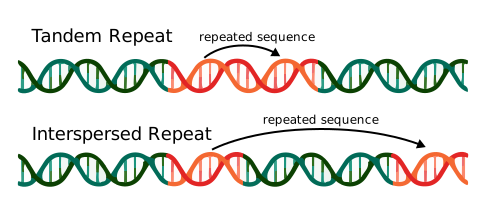
Therefore, if an organism has a large genome, we can not quickly deduce that it has more useful contenders for editing. It may just mean that there is more genetic material to search through before scientists are able to decide what to change.
Genome editing is not about cutting DNA anywhere you want. It is about making the right change at the right place.
This does not mean that editing strawberries is not possible
Scientists have already used genome editing in strawberries and other polyploid crops to improve traits like firmness, disease resistance, sweetness, and sustainability. Tools like CRISPR have been helpful because it can be designed to target multiple gene copies at once.
Polyploid crops are organisms that have more than two complete sets of chromosomes, meaning they carry multiple copies of many genes rather than just one or two.
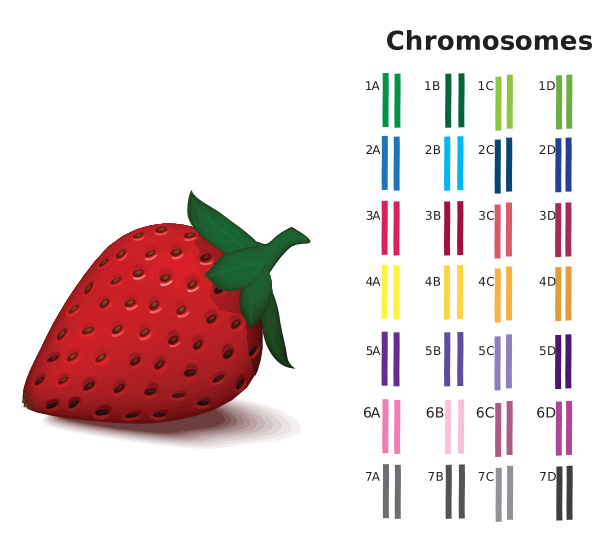
Large and polyploid genomes still require more testing, planning, and analysis than simpler genomes do. Scientists may need to design several guide RNAs, edit multiple copies of a gene, and spend more time checking results.
For example, cultivated strawberries are octoploid, meaning they have eight copies of each chromosome. In one study,1 researchers used CRISPR to target a gene on chromosome 6A called FaPG1, which is involved in fruit softening. A complication they faced is that chromosomes 6B, 6C, and 6D have similar but slightly different versions of this gene, which are called homeologues.
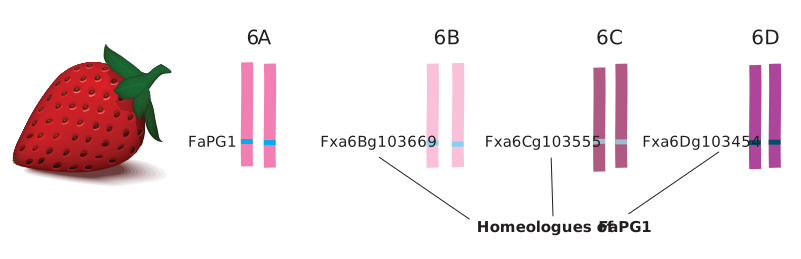
In order to specifically edit FaPG1, the researchers had to carefully compare this gene with its three homeologues to identify which parts of this gene’s sequence were unique. Once they found a sequence in this gene that was missing in the homeologues, they had to make sure they targeted this sequence on both copies of chromosome 6A. By carefully targeting and verifying edits across multiple gene copies, and checking to make sure there weren’t edits in the other chromosomes, the result was strawberries with firmer fruit.
The real limit is our understanding.
In the end, genome size in and of itself is not a good metric to use to measure how editable an organism is. A smaller genome can be easier to edit if scientists understand it well. A larger genome can be harder to edit if it is full of repeated DNA, similar gene copies, or poorly understood regions. In turn, the limiting factor is not how much DNA is present, it is how well scientists are able to understand the DNA that is present. This is why a large genome like a strawberry’s does not automatically mean there are more cool and/or helpful ways to modify it. Sometimes it just means more homework.

Read More:
- Mutant advantages: Constant change in plant breeding — random and now guided — has precisely crafted our global food system - Genetic Literacy Project
- C Value Paradox: Does Having A Larger Genome Make An Organisms More Complex?
- Sizes of genomes - The C‑value paradox
- NGS solutions for polyploid plant breeding challenges
Author: Shalese Jordan
When this answer was published in 2026, Shalese was a master’s candidate in the Department of Medicine at Stanford University studying translational research and applied medicine. Shalese wrote this answer while participating in the Stanford at The Tech program.