 Skip Navigation


How does the “two hit hypothesis” for breast cancer work?
July 31, 2026
- Related Topics:
- Cancer,
- Mutation,
- Medical genetics
A curious adult from California asks:
"How exactly does the “two hit hypothesis” for breast cancer work? If one person has a BRCA1 mutation, what are the odds this will actually lead to cancer in their children?"
Some of the most important genes in our genome are tumor suppressor genes. These include many of the genes that repair the rest of our genome, regulate cell growth and division, and detect and report cellular damage. As you can imagine, losing function in these genes, whether it be through inherited genetic variants from our parents or through mutations that occur due to aging or exposure to certain pollutants, can lead to uncontrolled cell growth, further DNA damage, and ultimately cancer. The two-hit hypothesis states that both copies of a tumor suppressor gene need to be broken or inactivated before full loss of anti-tumor function occurs.
How was the two-hit hypothesis first discovered?
The two-hit hypothesis was first proposed in 1971 by Alfred Knudson based on his study of retinoblastoma, a rare childhood eye cancer. Knudson observed that children with inherited or familial forms of the disease typically developed tumors at a much younger age and often in both eyes, whereas children with sporadic or non-hereditary retinoblastoma usually developed a single tumor in one eye later in childhood.1
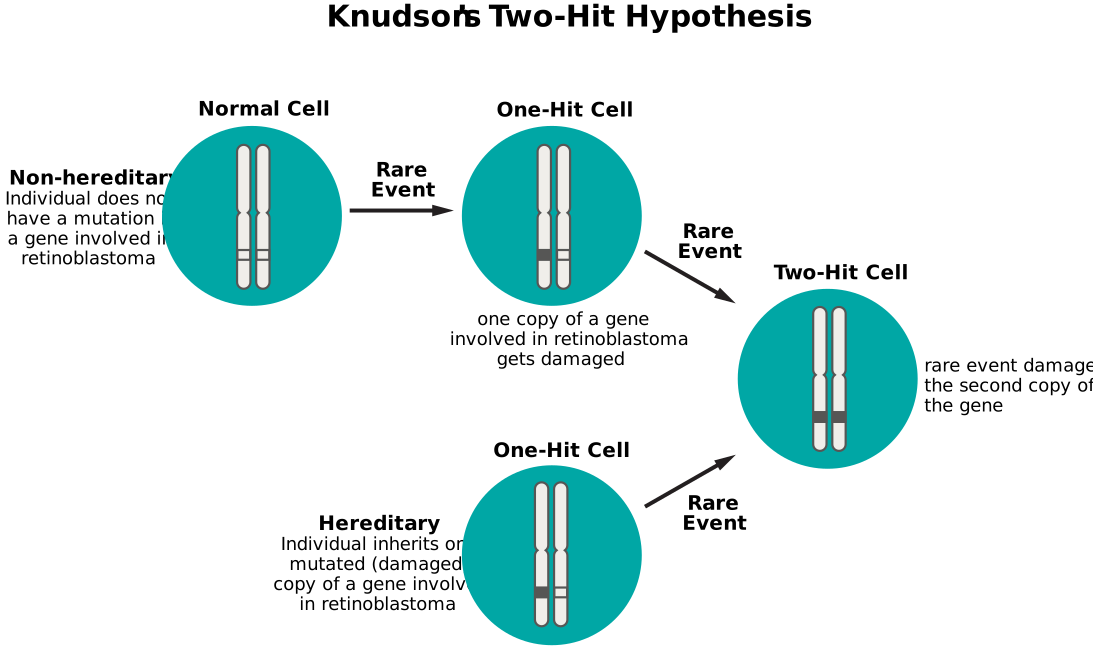
To explain these patterns, he proposed that retinoblastoma occurs after two genetic "hits" disable both copies of a (then unknown) cancer-protective gene. In hereditary cases, children inherit the first hit from one parent in all of their cells and need only acquire a second hit in a retinal cell for a tumor to form. In sporadic (non-hereditary) cases, both hits must occur independently within the same cell, a much less likely event that explains the later onset and lower frequency of tumors.
Knudson's model was later validated by the discovery of the RB1 gene, a tumor suppressor gene that regulates cell division, and has since become a foundational principle in cancer genetics. Two-hit inheritance patterns are commonly observed among many hereditary cancers, including those involving BRCA1 and BRCA2.
How is BRCA1 and BRCA2 cancer risk inherited?
BRCA1 and BRCA2 are two of the most well-known and studied tumor suppressor genes. Both genes play critical roles in DNA repair machinery. When these genes are working properly, they help maintain the genome stability and repair potentially harmful mutations that naturally accumulate in our cells over our lifetime. As you might expect, loss of either BRCA1 or BRCA2 function leads to the accumulation of further genetic mutations, genomic instability, and potentially several forms of cancer. Like with RB1 and retinoblastoma, people who inherit just a single nonfunctional BRCA1 or BRCA2 variant from either parent are at much higher risk for developing certain types of cancers at some point in their life (most famously, breast cancer).
Because a second BRCA loss of function mutation is required, not all people who inherit BRCA mutations develop cancer. Nevertheless, the risk is substantially higher than in the general population. Women who inherit a harmful BRCA1 mutation have an estimated lifetime breast cancer risk of roughly 60–70%, compared with about 13% for women overall.2
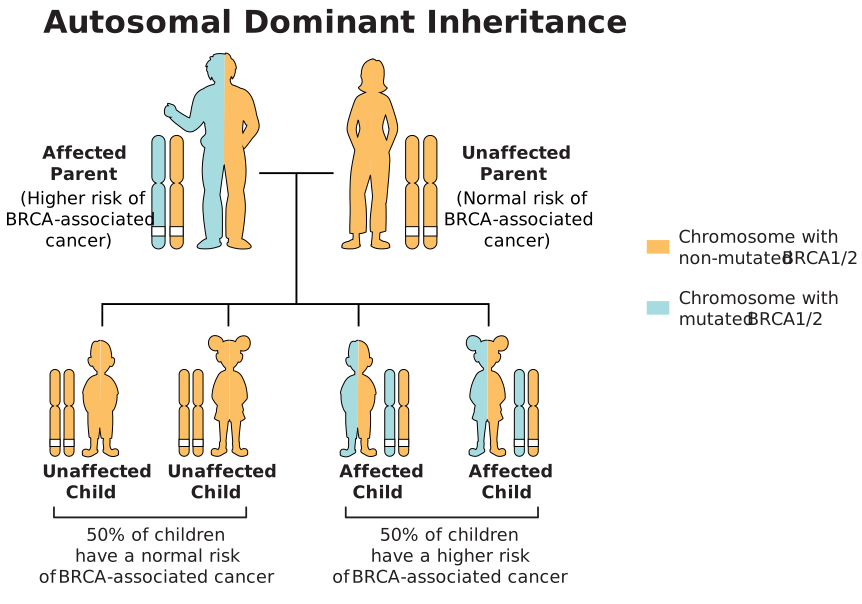
If a parent carries a BRCA mutation, each child has a 50% chance of inheriting the mutation, which substantially increases their risk for developing certain cancers (but does not guarantee it). Since BRCA genes play a really important role in genome stability, it is very rare for people to have mutations in both copies of the BRCA gene; such conditions are typically lethal.
What can be done to decrease breast cancer risk resulting from BRCA mutations?
Since BRCA1/2 mutations are so well-documented, genetic tests identifying these mutations are readily available, especially for those with a family history of BRCA-associated cancers. For those who discover they do carry one of these mutations, there are a growing number of resources and treatments that can reduce cancer risk, or detect cancer in early stages when it is easier to treat.

Read More:
-
Previous Ask-a-Geneticist articles on BRCA
-
National Cancer Institute BRCA fact sheet
-
MedlinePlus articles on BRCA testing, BRCA1, and BRCA2

Author: Adam He, PhD
When this answer was published in 2026, Adam was a postdoctoral scholar with Anshul Kundaje’s laboratory in the Department of Genetics, developing computational methods to read and re-engineer the regulatory DNA code. Adam wrote this answer while participating in the Stanford at The Tech program.