 Skip Navigation


Can a DNA test tell you about gender identity?
November 28, 2026
- Related Topics:
- Gender identity,
- LGBTQ+,
- Complex traits,
- Genetic testing,
- Medical genetics
A curious adult asks:
“Can genetic sequencing identify genes that may influence a person to experience gender dysphoria? Are there genetic counselors who can help interpret sequencing in this regard?”
First, some helpful words that will help you understand this article
Gender identity is a person’s inner sense of their own gender. A transgender person has a gender identity that is different from the sex they were assigned at birth. For a cisgender person, the two match.
Gender dysphoria is the distress some people feel when their body or assigned sex doesn’t match their gender identity. Not every transgender person experiences it. And being transgender is not a mental illness. In 2019, the World Health Organization moved gender-related diagnoses out of its list of mental disorders.1
Can DNA predict gender identity?
Most genetic studies look at gender identity, usually in transgender people who have sought medical care. So that’s mostly what I’ll discuss here.
The short answer to this question is: not right now. Genes probably play some part in shaping gender identity. But no one has found a gene, or a concrete group of genes, that can predict it. So today, no genetic test can tell whether someone is transgender or will experience gender dysphoria.
But yes, genetic counselors can help! They can explain what your DNA results mean for your health. They can also walk you through what science does (and doesn’t) know about genes and gender. What they can’t do is read a gender identity “answer” from your DNA, because there isn’t one that we know of, or that scientists have found yet.
Here’s the longer answer:
Do genes play a role?
One way scientists check whether genes shape a trait is by studying twins.
Identical twins share nearly all of their DNA. Fraternal twins share about half, just like any other siblings. If genes matter for a trait, identical twins should match more often than fraternal twins.
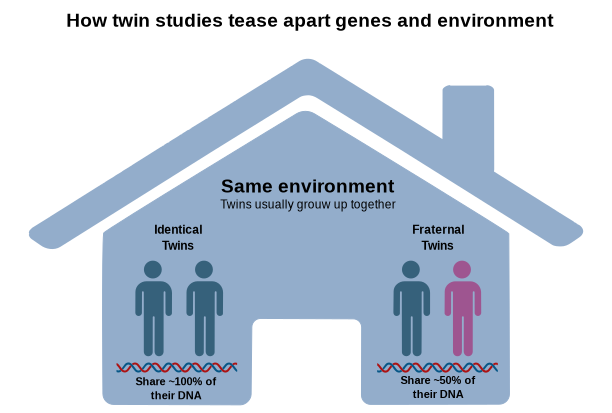
Several twin studies suggest that genes do play some part in gender identity. But the numbers jump around a lot from study to study.2 Many of these studies were small, since few twin pairs include a transgender person.
A large Swedish study looked at health records from 2001 to 2016. Surprisingly, it found no same-sex twin pairs in which both twins had gender dysphoria. The authors suggested that shared conditions before birth, like the environment in the womb, may matter more than genes.3 But the study included fewer than 70 twins, so it’s hard to draw firm conclusions.
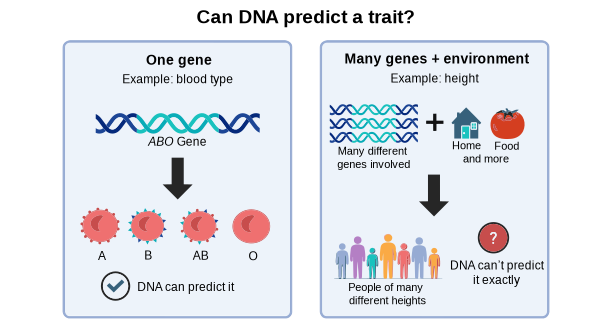
Putting it all together, many scientists think gender identity is shaped by lots of genes, each with a small effect, along with other factors.2
You can think of it as being more like height than like blood type. Your blood type is set by a single gene, so a DNA test can predict it perfectly. Height seems simple, but it’s more complicated than it looks. Doctors can use growth charts and parents’ heights to estimate how tall a child will grow, but these are only rough guesses. That’s because height is shaped by thousands of genetic differences, plus things like nutrition and health during childhood. Scientists needed DNA from 5.4 million people just to map most of the common genetic differences linked to height.4 Even with this information, they still can’t predict exactly how tall one person will be. Gender identity is likely complicated in a similar way, and scientists don’t yet know which genes to look at.
Have scientists found any “gender identity genes”?
Not yet. A few studies have searched, but they’ve all been small.
In 2019, a team in Australia compared 380 transgender women with 344 cisgender men. They looked at 12 genes involved in how the body responds to sex hormones. Certain versions of these genes were more common in the transgender women.5
That same year, a team in Georgia read the protein-coding genes of 30 transgender people. They found rare variants in genes linked to how hormones like estrogen shape the developing brain.6
Both findings still need to be confirmed in much bigger groups of people. The Georgia team called its own results preliminary.6 Finding genes with tiny effects usually takes hundreds of thousands of people. Compare 30 people to the 5.4 million in the height study!
And even if scientists someday find genes linked to gender identity, each one would likely nudge the odds only a tiny bit. Together, they still wouldn’t be able to predict who a person is.
So can a DNA test tell me anything about gender?
Not about gender identity or gender dysphoria. There is no medical or at-home DNA test that can do this.
Gender identity is something people know about themselves. A DNA test can’t confirm it or rule it out.
Why is this research sensitive?
Transgender people have mixed feelings about genetic studies of gender identity. In one survey of 409 transgender and gender-diverse people, about 7 in 10 said this kind of research made them feel hopeful.7 Some hope it could show that being transgender is a natural part of human diversity, or lead to better health care.
Others are worried. In interviews, some transgender and gender-diverse people shared fears that genetic findings could be used to discriminate against them, to treat being transgender as something to “fix,” or to limit access to gender-affirming care.8 That’s why many researchers say transgender communities should help guide this research.8
Can a genetic counselor help?
Yes! Genetic counselors are health care professionals trained in both genetics and counseling. They help people understand what genetic test results mean for their health and their families.
For transgender and gender-diverse people, a genetic counselor can:
- Explain sequencing results for health conditions, like inherited cancers or heart conditions.
- Talk through how gender-affirming hormones or surgeries might affect things like cancer risk and screening.9
- Explain what the science on genes and gender identity does, and doesn’t, show.
What they can’t do is look at your DNA and tell you whether it “explains” your gender identity. The science just isn’t there.
To find a genetic counselor, try the National Society of Genetic Counselors’ Find a Genetic Counselor directory. Depending on where you live, and your health insurance, you may need a referral from your primary care doctor first. It’s also okay to ask a counselor whether they have experience working with transgender and gender-diverse patients.
So what does this mean?
Genes probably play some part in gender identity. But it’s a complex trait, shaped by many genes and other factors such as upbringing and environment. No DNA test can predict it or explain it today.
Genetic counselors can still be a great resource. They can help you understand what your DNA says about your health, and what science has (and hasn’t) learned about genes and gender.

Read More:
- National Society of Genetic Counselors: Find a Genetic Counselor
- MedlinePlus: What is genetic counseling?
- MedlinePlus: Is height determined by genetics?
- American Psychological Association: Understanding transgender people, gender identity and gender expression
- World Health Organization: Gender incongruence and transgender health in the ICD
- Ask a Geneticist: Who can I talk to about my genetics?

Author: Ashley Yeh
When this answer was published in 2026, Ashley was a Ph.D. candidate in the Neuroscience program, working jointly in the laboratories of Julia Kaltschmidt and Christoph Thaiss. Her research explores the gut-brain axis, focusing on how the vagus nerve communicates with the enteric nervous system of the gut. Ashley wrote this answer while participating in the Stanford at The Tech program.