 Skip Navigation


How are “instincts” passed on through genetics?
July 23, 2026
- Related Topics:
- Evolution,
- DNA basics,
- Genetic variation,
- Complex traits,
- Mutation
A curious adult from California asks:
"How are “instincts” passed on through genetics?"
As soon as a baby sea turtle is born, they start making their way towards the ocean, even though they have never been in the sea. Every fall, monarch butterflies migrate thousands of miles without a map. Young birds can build nests even when they have never seen another bird do it. And almost immediately after a human baby is born, they know how to suckle and drink milk.
How can these animals know how to do these things before anyone teaches them?
The answer is instincts. Instincts are behaviors that animals are born knowing how to do.
So where do instincts come from?
Are instincts somehow written into DNA and passed on through genetics?
Sort of, but not in the way you might think.
Genes don't contain the exact instruction manual that says "crawl to the sea" or "migrate south." Instead, the genes that collectively influence these behaviors are favored by a process called natural selection and get passed on for many generations.
So to understand how instincts are passed down, we need to talk about natural selection.
Natural selection is actually quite simple and very random. In every generation, each individual is born with very small and random differences in their DNA, called DNA mutations. Most of these differences don’t matter very much. But every once in a while, a difference helps an animal survive more or have more offspring than their peers. That is where things get interesting.
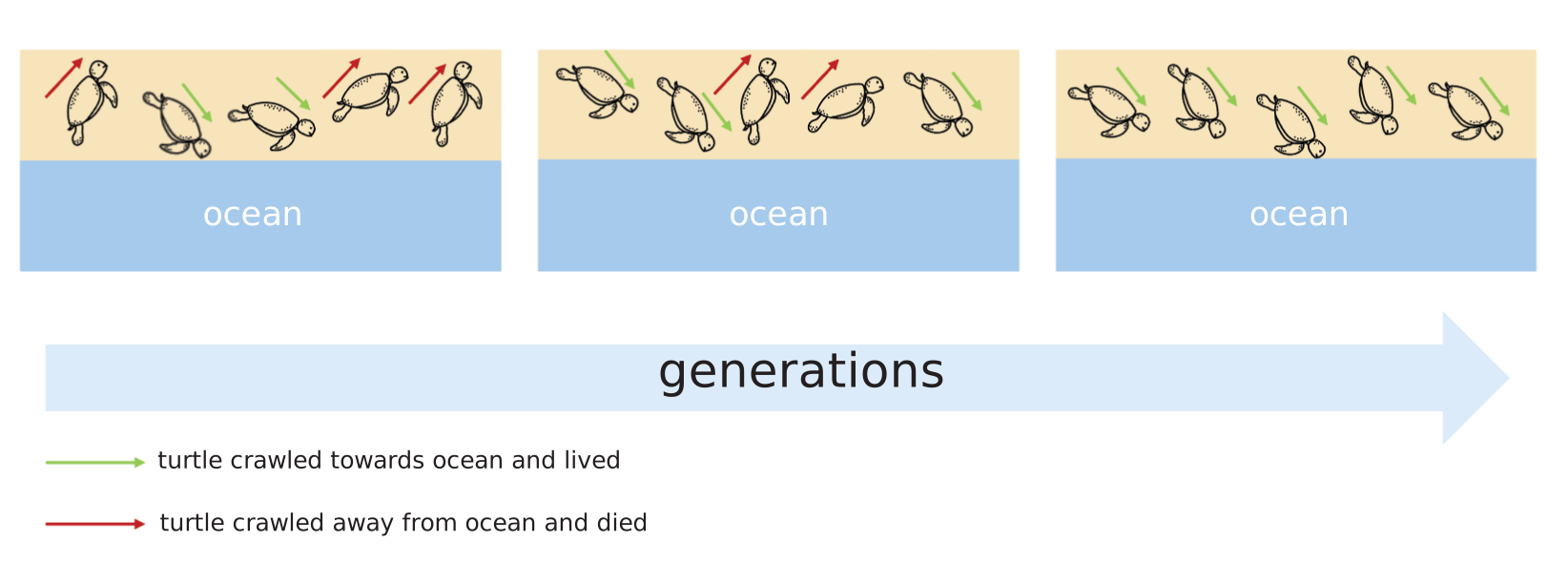
Let’s take the baby sea turtle example. Imagine that a long time ago some hatchlings had DNA mutations that made them crawl toward the ocean, while others had mutations that sent them crawling in random directions. The first group reached the safety of the water faster and survived more often. The second group was more likely to get eaten by predators before ever making it to the water. Over thousands of generations, the mutations linked to the "crawl toward the ocean" wiring became more and more common, simply because turtles with those random genetic differences kept surviving and reproducing, generation after generation.
Can we actually point to the genes that shape instincts?
For most instincts, scientists can’t point to one specific gene and say “this is the crawl to the ocean gene,” or “this is the butterfly migration gene.” Behaviors like these usually involve tens or even hundreds of genes working together, each one playing a small part in building an animal’s nervous system. When scientists compare animals with different instincts, they often find many small DNA mutations scattered across the animal’s genome rather than one big difference in one place. This is because instincts have been subtly tuned by evolution for millions of years.
So how exactly do genes build an instinct?
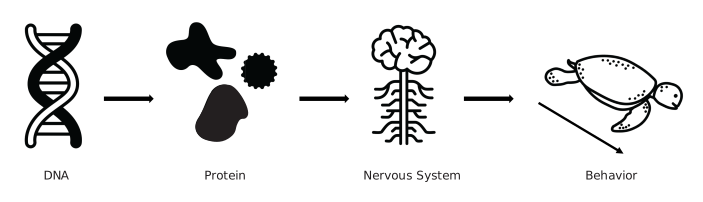
To understand how genes relate to instincts, it is helpful to think of genetics as a sort of chain reaction. Genes are the instructions in an animal’s body for how to make specific proteins. Proteins are the workhorses that actually build and organize the entire body—including the brain and the nervous system.
During an animal’s development, proteins tell neurons how to grow, where to connect, and how sensitive to be to certain signals. All of this development happens before an animal is actually born. By the time a baby animal is born, their nervous system is already wired to respond to the world in very particular ways. So when a turtle hatchling is born, sees the bright open horizon over the water and feels the downward slope of the sand, their nervous system fires in a way that tells them to crawl towards the water.
So then what is actually being passed on through genetics?
The instinct itself is not what gets inherited. The baby turtle does not explicitly inherit “crawl to the ocean” as a line of code in their DNA. Rather, the baby turtle inherits a set of specific genes (selected for through natural selection) that help build their nervous system in a way that they are primed to respond to certain cues in a particular way.
This is the key to the heritability of instincts: genetics build the hardware and natural selection (over many generations) decides which hardware survives to be passed down to the next generation. So the next time you watch a baby turtle race toward the ocean or a monarch butterfly making their massive journey, you're really watching the product of millions of years of natural selection!
Photo credit for banner image: Bethany McCarter, CC BY 4.0, via Wikimedia Commons


Author: Sayde Perry
When this answer was published in 2026, Sayde was a Ph.D. candidate in the Department of Microbiology & Immunology at Stanford University. She studies horizontal gene transfer in the human gut microbiome in Ami Bhatt and Leonor Garcia-Bayona’s labs. Sayde wrote this answer while participating in the Stanford at the Tech Program.