 Skip Navigation


Why are jalapeños less spicy now?
October 6, 2026
- Related Topics:
- DNA basics,
- Gene expression,
- Environmental influence,
- Evolution,
- Plant biology
A curious adult from California asks:
"Why are jalapeños less spicy now?"
For millions of years, peppers evolved a chemical weapon specifically designed to fend off mammals. But, humans started farming them anyway and within decades, bred the chemical weapon away.
So if you have bitten into a jalapeño recently and thought, “hm this doesn’t taste very spicy,” you aren’t imagining it! You haven’t built up a new spice tolerance. Jalapeños are actually getting less spicy. And the reason why comes down to genetics.
What even is spiciness?
To understand the reason why jalapeños have become milder, we first need to talk about what spiciness is in the first place.
Spiciness is the burning sensation we experience when we eat foods that produce a compound called capsaicin. Capsaicin production is controlled by a small number of genes in the pepper plant. Different variations in those genes can cause more or less capsaicin production and therefore more or less spiciness.
When we eat capsaicin, it directly binds to receptors in our mouths called TRPV1. This binding makes the TRPV1 receptors activate which tells our brains that we are experiencing heat or burning. So capsaicin doesn’t actually burn our mouths, but it tricks our brains into thinking we are perceiving a burning sensation. You can think of TRPV1 like a smoke detector. Capsaicin isn’t actually a fire, but it acts like steam or smoke that trips the alarm anyways. Interestingly, different types of animals have different versions of the TRPV1 receptor which makes them experience capsaicin differently.
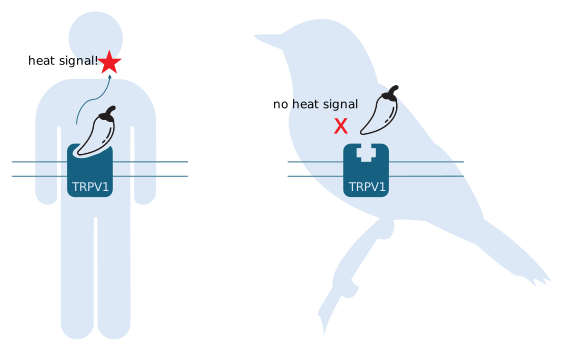
Scientists can actually measure spiciness using something called the Scoville Scale. This scale measures the concentration of capsaicin in different peppers. On the Scoville Scale, jalapeños typically measure between 2,500 and 8,000 units which is quite a large range, but recently, more and more jalapeños are scoring on the lower end of that range.
Why are peppers spicy in the first place?
It turns out that peppers didn’t start producing capsaicin by accident. Peppers, like all plants, need their seeds to spread. And birds, but not mammals, are ideal seed spreaders. Birds can swallow peppers whole, fly long distances, and then deposit seeds intact and ready to grow. Mammals on the other hand need to chew peppers. In this process, they grind up the seeds and destroy them so they can’t grow.
So how can a pepper ensure that it gets eaten by a bird and not a mammal? Capsaicin!
Birds actually have a different version of the TRPV1 receptor than mammals. Their receptors can’t bind to capsaicin and therefore don’t get activated to send burn signals to their brains. Birds could eat the spiciest peppers on the planet and not feel a thing! Mammals on the other hand have the version of the TRPV1 receptor that binds to capsaicin perfectly, which means that when mammals eat peppers they sense a strong burning sensation. So peppers basically evolved a mechanism that discourages mammals, but importantly not birds, from eating them. You can think of this like a lock and key. Capsaicin is a key that fits perfectly into the mammal version of the TRPV1 lock. But the bird version of the lock is a slightly different shape and the key won’t fit.
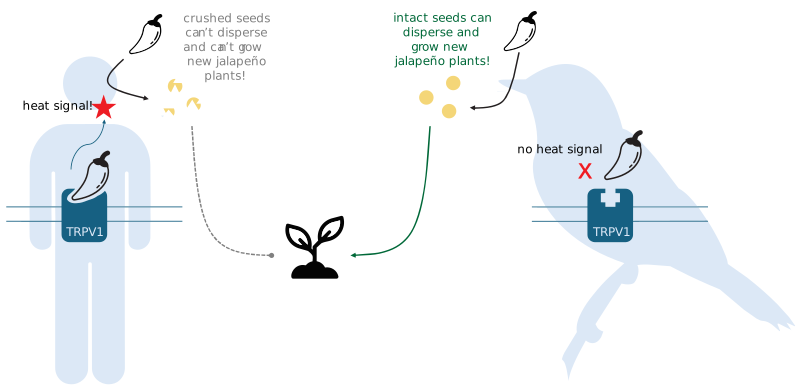
But, this didn’t work on humans forever. Humans started eating peppers anyway and started to farm them. This is where things get interesting.
So what happened to the jalapeño?
To understand how humans changed the jalapeño, we need to talk about something called selective breeding. Selective breeding is when humans intentionally, or sometimes even unintentionally, choose which plants to reproduce based on traits we care about. Over many generations those traits become more and more common.
When farmers started growing jalapeños at scale, they weren’t thinking too much about spiciness. They were thinking about other things that commercial farmers care about such as the pepper’s size, its resistance to disease, and its consistency. In selectively breeding for these factors, farmers actually also gradually selected for jalapeños that are less spicy as a byproduct. Part of this is because pepper plants naturally produce more capsaicin when they are under stress, for example if they are growing in a drought or poor soil. Large scale commercial farming does the opposite. It involves consistent watering and fertilization, which means that the jalapeños grow up in a low stress environment. This means that the pepper produces less capsaicin and tastes less spicy.
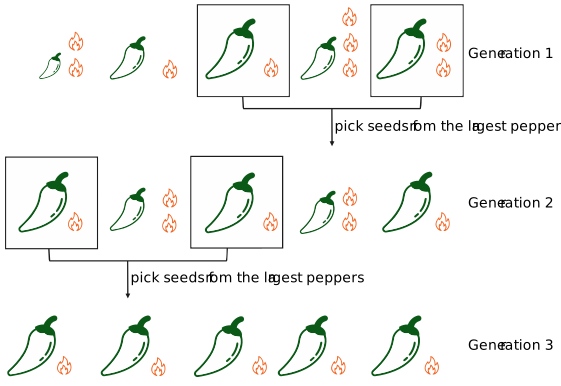
So, could we bring back the heat?
Yes! Capsaicin production is still encoded in pepper genetics. Commercial farming didn’t erase it, it just stopped prioritizing it. When growers start selecting for heat instead of size and consistency, the pepper will respond.
In fact, humans have already shown that we can select for spiciness when we really want to. The Carolina Reaper, one of the spiciest peppers in the world, didn’t exist until a breeder in South Carolina decided to spend years trying to select for a pepper variety that produces the maximum amount of capsaicin.
So, the jalapeño is really just a product of its pressures.
Peppers spent millions of years evolving a specific chemical weapon to keep mammals away. Then humans domesticated them anyway, scaled production up, and optimized for size and consistency. In doing so, humans became a pressure themselves. The heat started to disappear because we weren’t selecting for it. Nature spent millions of years making the jalapeño spicy. It only took us a few decades to reverse it.
Photo credit for banner image: Epp, CC BY-SA 3.0 , via Wikimedia Commons

Read More:
-
Science Daily: For Peppers, "Hot" Quite Literally The Spice Of Life
-
BBC Bite Size: Species and selective breeding - Inheritance and genetics
- Discover Magazine: Certain Animals Tolerate Spicy Foods Better Than Others
-
Frontiers for Young Minds: How a Boy Who Loved Hot Peppers Contributed to Pain Research

Author: Sayde Perry
When this answer was published in 2026, Sayde was a Ph.D. candidate in the Department of Microbiology & Immunology at Stanford University. She studies horizontal gene transfer in the human gut microbiome in Ami Bhatt and Leonor Garcia-Bayona’s labs. Sayde wrote this answer while participating in the Stanford at the Tech Program.