 Skip Navigation


Can animals with odd numbers of chromosomes be fertile?
July 14, 2026
- Related Topics:
- Chromosomes,
- Speciation,
- Meiosis,
- Animal biology
A teacher from North Carolina asks:
"Is it possible for an animal to have an uneven number of chromosomes and still be fertile?"
When you think of animals with uneven numbers of chromosomes, you might think of hybrids such as mules (born to a donkey dad and a horse mom), and hinnies (born to a donkey mom and a horse dad). While we might think of such animals as infertile, scientists have found that mules and hinnies can have babies though this is rare and only clearly documented in females.1
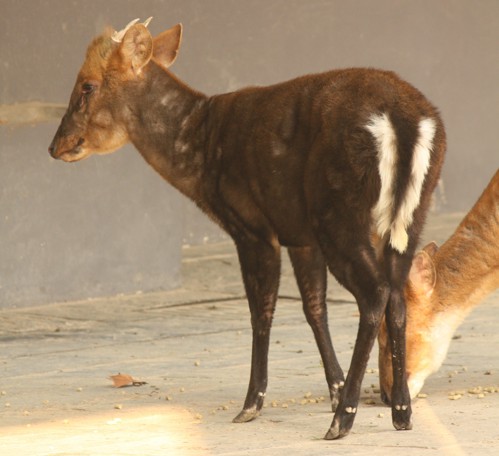
But hybrids are not the only animals with uneven numbers of chromosomes. Transcaucasian mole voles have 17 chromosomes. In some animals, healthy males have a different number of chromosomes from healthy females. Black muntjacs are a species of deer where males have 9 chromosomes while females have 8 chromosomes.2 How does this work?
How are uneven chromosome numbers related to fertility?
As highlighted in this beautifully written “Ask-a-geneticist” article on why mules are generally considered infertile, the issue with uneven chromosome numbers occurs when eggs or sperm are made.
Let’s use humans as an example. Most humans have 46 chromosomes. We receive 23 from mom and 23 from dad. For each chromosome we receive from mom, we receive a similar one from dad that encodes the same kinds of genes. A matching pair of chromosomes encoding the same kinds of genes are referred to as homologous chromosomes or homologues.
Since mom herself has 46 chromosomes but only gave us 23, mom’s egg must have 23 chromosomes, which is half of what she has. This is true for dad’s sperm as well. To ensure that each sperm and each egg only has one of each of the 23 chromosomes instead of a pair, sperm and eggs undergo a special kind of cell division called meiosis.
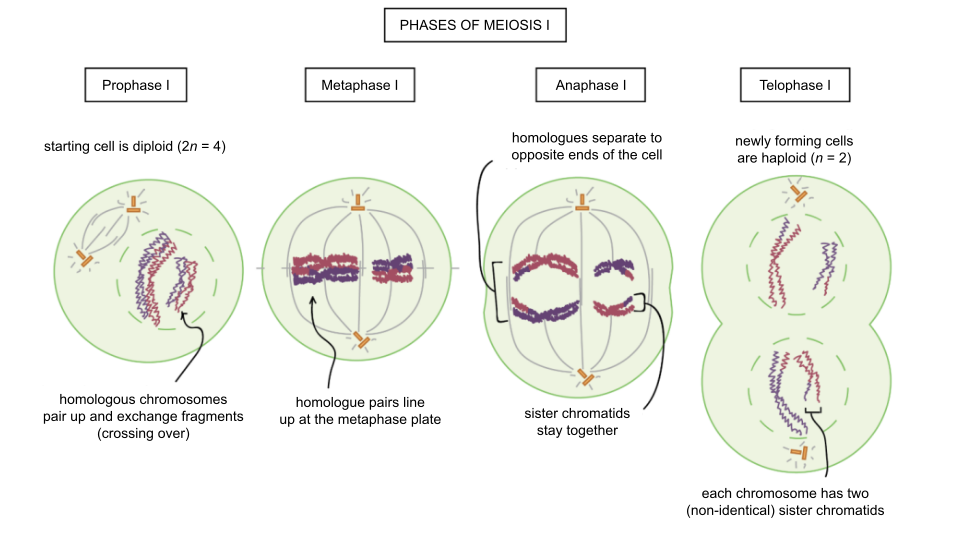
During meiosis, each pair of homologous chromosomes is matched up and joined by a zipper-like structure. The joined homologue pairs are lined up in the center of the cell as seen in the first cell in the cartoon above. Then the two chromosomes of each homologous pair are pulled apart towards opposite ends of the cell. The cell can then divide in the middle, fully separating the homologues into 2 separate cells.
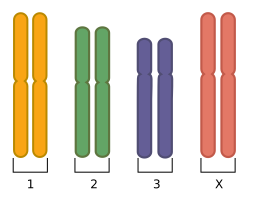
Black muntjac females have 4 homologous pairs of chromosomes. During meiosis, these 4 pairs can be paired up and lined up in the middle, then pulled apart to opposite ends of the cell. Once the cell divides in the middle into two cells, each of the new cells has 4 chromosomes. There are a few more steps but this first part of meiosis gives us black muntjac eggs with 4 chromosomes.
What about meiosis to make black muntjac sperm?
Black muntjac males have 9 chromosomes because instead of a pair of sex chromosomes, they have 3 sex chromosomes; X, Y1 (the smaller Y chromosome) and Y2 (the larger Y chromosome). If we refer back to our earlier discussion of meiosis, we see an issue arise. The first six chromosomes can pair up just fine and be separated since they are 3 homologous pairs. But what happens with the sex chromosomes?
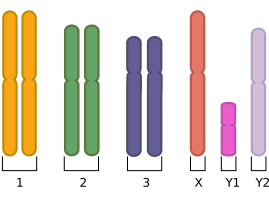
Scientists discovered the answer by observing cells from Indian muntjac testes since they also have 3 sex chromosomes. They noticed that a zipper-like structure joins one end of the X chromosome to Y1 and another joins Y2 to the other end of X.3 So one end of the X chromosome pairs with Y1 and the other end pairs with Y2. This allows the three sex chromosomes to be oriented in the center of the cell so they can be pulled apart during meiosis. Consistent with this observation, the scientists saw that Y1 and Y2 are always pulled in the same direction towards one end of the meiotic cell, while the X chromosome is pulled in the opposite direction.3 This leads to 2 different kinds of black muntjac sperm after meiosis; one kind with the X chromosome but no Y chromosomes, and the other kind with both Y chromosomes but no X chromosome.
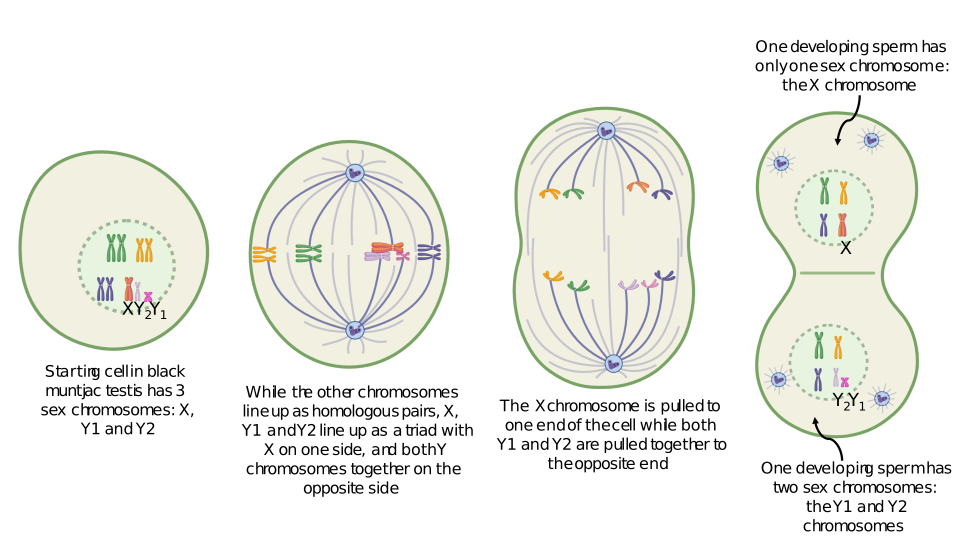
When black muntjac sperm carrying both the Y1 and Y2 chromosomes fuses with an egg, the resulting embryo is a male. When black muntjac sperm carrying the X chromosome fuses with an egg, the resulting embryo is a female.
What about transcaucasian mole voles?
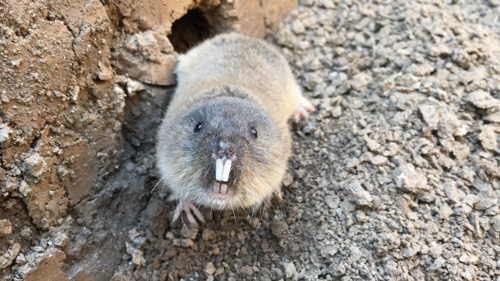
Transcaucasian mole voles are rather mysterious. Both males and females have 17 chromosomes: 8 pairs of chromosomes and a single sex chromosome (the X chromosome). Males and females cannot be distinguished on the basis of their chromosomes. Scientists are not quite sure how male and female transcaucasian mole voles can carry the same chromosomes but develop differently into males and females, producing sperm and eggs respectively.
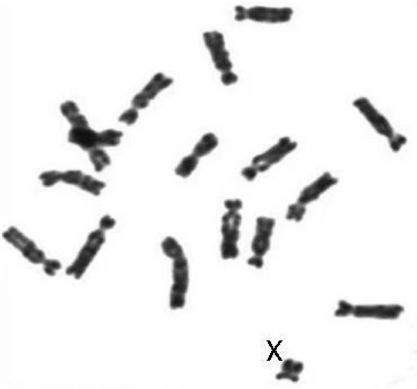
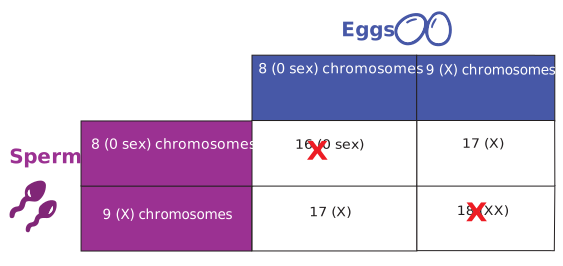
Unlike in black muntjacs where the extra “odd” sex chromosome forms a triad with the two other sex chromosomes and is matched during meiosis, scientists have observed the X chromosome of transcaucasian mole voles to be entirely unmatched during meiosis in developing sperm.5 Thus we would expect half the eggs or sperm to end up with 9 chromosomes including the X chromosome, while the other half end up with 8 chromosomes (no sex chromosome). Indeed scientists have observed developing sperm cells with either 8 chromosomes or 9 chromosomes.6
When a sperm with 8 chromosomes fuses with an egg with 8 chromosomes, the X chromosome is missing. While sex chromosomes (X and Y chromosomes) in mammals typically encode the genes responsible for sex determination and development, they usually also encode other important genes needed for survival and normal development. So entirely missing sex chromosomes would likely result in an embryo that is nonviable. The fact that scientists have not reported finding any transcaucasian mole voles with 16 chromosomes (missing the X chromosome) supports this hypothesis.
When a sperm with 8 chromosomes fuses with an egg with 9 chromosomes (or vice versa), we would expect this embryo to be viable since this is the number of chromosomes transcaucasian mole voles have. But what happens when a sperm with 9 chromosomes fuses with an egg with 9 chromosomes? We would expect the resulting embryo to have 18 chromosomes, including two X chromosomes. In many mammals, an embryo with two X chromosomes develops into a female. However, scientists have not documented the existence of such transcaucasian mole voles.
Why are there no transcaucasian mole voles with two X chromosomes?
Our best guess for why there are no transcaucasian mole voles with two X chromosomes involves a process called X-chromosome inactivation. This process switches off all (most) gene expression on one of the two X chromosomes in mammals with two X chromosomes (usually females), leaving only one active X chromosome.
As mentioned earlier, X and Y chromosomes encode other important genes apart from sex determining genes. Y chromosomes in humans are smaller than X chromosomes and encode far fewer genes. The X chromosome is necessary for human embryos to be viable, but the Y chromosome is not. While there are humans with a single X chromosome as their only sex chromosome (they have Turner’s syndrome), there are none with a Y chromosome as their only sex chromosome.
Since human females have two X chromosomes while males only have one, we would expect females to have twice as much of the genes encoded on the X but not the Y chromosome. And it turns out more is not always better, because this much X chromosome gene expression is considered potentially lethal. X-chromosome inactivation protects human females from this. In a developing human female embryo, one of the two X chromosomes expresses a gene called XIST that inactivates that particular X chromosome, leaving the other X chromosome active.
Since transcaucasian mole voles only have one X chromosome, we would expect X chromosome inactivation to be unnecessary in these animals. While their X chromosome still carries the XIST gene, there is some evidence to suggest that this XIST gene may not be fully functional. Scientists have found a deletion in the XIST gene of transcaucasian mole voles compared to that of the closely related southern mole voles.7 For this reason, the prevailing hypothesis is that transcaucasian mole vole embryos with two X chromosomes do not survive because they are unable to sufficiently inactivate the second X chromosome, leading to lethal levels of X chromosome genes.
But how are mules any different from the case of transcaucasian mole voles?
In both mules and transcaucasian mole voles, we have an entirely unpaired chromosome during meiosis. Transcaucasian mole voles appear to make normal eggs and sperm despite this. Though mules can produce eggs and sperm, scientists have observed that many of these usually have abnormalities. While we don’t have a clear answer as to why the outcomes appear to differ, there is an important difference we need to address. In both cases discussed in detail above, the uneven number of chromosomes is related to the number of sex chromosomes in these species. The above examples are representative of what we know so far; odd numbers of sex chromosomes appear to account for the majority of documented cases of species with uneven numbers of chromosomes. In the case of hybrids like mules, the unmatched chromosome is not a sex chromosome.
Conclusion
While we think of mammals with uneven chromosome numbers as sterile, this is not so for species where most individuals generally have uneven numbers of chromosomes. Documented cases of such mammalian species are more rare, so we tend to think of them as exceptions to the rule.
Though this discussion has focused on uneven chromosome numbers in mammals, there are quite a few such examples among other kinds of animals, including reptiles and insects. Many of these examples, as in mammals, are related to uneven numbers of sex chromosomes. But there are some especially intriguing exceptions as well. Common checkered whiptail lizards have triads of homologous chromosomes instead of pairs; in total, they have 69 chromosomes.



Read More:
- There are 12 muntjac species with widely ranging numbers of chromosomes; from 6/7 in indian muntjacs to 46 in chinese muntjacs! Despite this huge difference in chromosome numbers, Indian and Chinese muntjacs can successfully breed.
-
In some insects there can be a big difference in the number of chromosomes in males and females. Female honey bees have twice the number of chromosomes (32) as males (16)!
-
Here are some facts about the Y chromosome! You can also read more about X chromosome inactivation here! And it turns out the inactive X chromosome in female mammals with two X chromosomes is not entirely inactive!
Author: Nana Ansuah Peterson
When this answer was published in 2026, Nana Ansuah was a Ph.D. candidate in the Microbiology and Immunology department studying subgenomic transcription in SARS-CoV-2 in Peter Sarnow’s laboratory. She wrote this while participating in the Stanford at The Tech program.