 Skip Navigation


Why are there more subtypes of A blood than B blood?
July 28, 2026
- Related Topics:
- ABO blood type,
- Blood type,
- Human evolution
A curious adult from California asks:
"Why are there several subtypes of type A blood, but not so much for type B blood? What is the evolutionary purpose of this, and does it cause any issues when blood type tests are being done?"
There are several major likely explanations for why the A blood type appears to have many more subtypes than the B type. These can be summarized as age (the A blood type is older than the B subtype), demographics (A’s are much more common than B’s), and molecular biology (B subtypes more frequently mutate into O’s).
What determines ABO blood types and where do they come from?
We’ve previously written about ABO blood types (see the Read more section below), but it’ll be helpful to briefly cover what blood types are and how they work. A person’s blood type is determined by the type of antigens (special molecular markers) present on the outside of their blood cells.
People with type A blood have A antigens, type B blood has B antigens, type AB has both A and B antigens, and type O has neither antigen. There are other types of antigens that can cause other blood type systems (you may have heard of the Rhesus/Rh antigen and blood type), but the ABO system is the one that’s the most famous and arguably most important.
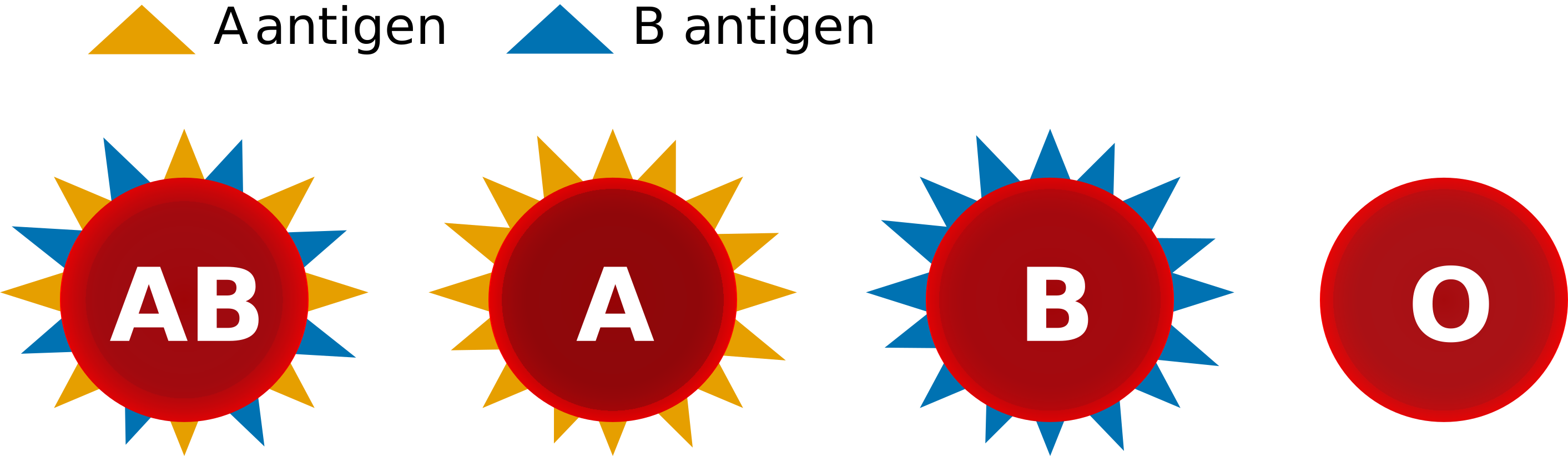
In the ABO blood system, each antigen refers to different sugar molecules that get added to the surface of our blood cells. The gene that causes these sugars to get added is, rather uncreatively, named ABO. This gene comes in three major variants corresponding to “A” (N-Acetylgalactosamine), “B” (galactose), or “O” (no sugar) added.
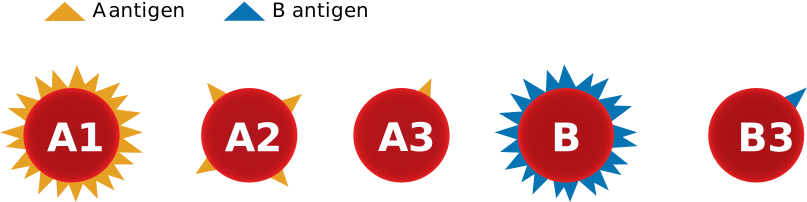
A1, A2, A3, Ax, … B, B3, Bx, Bw …
It turns out that there are actually a whole zoo of subtypes within each of the main ABO blood types. The different subtypes don’t actually cause different or new antigens to be added, but rather vary in how much of the main blood type antigens are present.
For example, the main difference between A1 and A2 individuals is that A2 individuals have approximately one fifth as many A antigens on the surface of their blood cells.1 There are two fairly common A subtypes (A1 and A2), and many rarer subtypes, but really only one common B subtype (B).2 Most of the rare subtypes of A and B produce much lower levels of antigens compared to the main A1, A2, and B subtypes.2
So why so few B subtypes?
Each of these subtypes arises from mutations to existing copies of A, B, or O variants of the ABO gene. The A variant is older and more common than the B variant.3 As a result, it has had a lot more time and bodies in which to accumulate small mutations, leading to lots of A subtypes (even though many of these are quite rare). Moreover, the B variant of ABO seems to be a lot more sensitive to mutations.2 Many B subtypes have almost no expression of the B antigen, leading to blood typing results that look like type O.


Author: Adam He, PhD
When this answer was published in 2026, Adam was a postdoctoral scholar with Anshul Kundaje’s laboratory in the Department of Genetics, developing computational methods to read and re-engineer the regulatory DNA code. Adam wrote this answer while participating in the Stanford at The Tech program.