 Skip Navigation

The AI Sustainability Challenge
Duration: 90 minutes
Grade Levels: 6–12
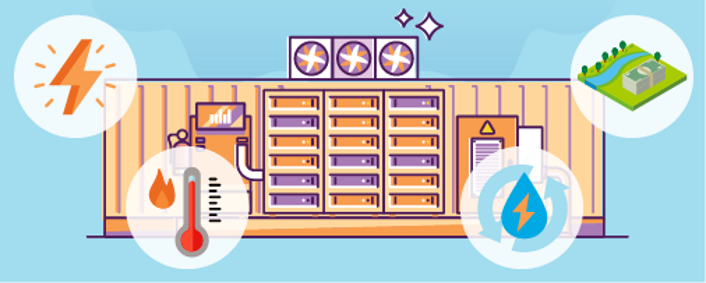
In this lesson, learners consider the environmental challenges posed by the increasing use of Artificial Intelligence (AI). Each team of learners develops and presents ideas for sustainable approaches to reducing the negative impacts of AI advancements.
Grade Levels: 6-12
Duration: 90 min
Concepts/Skills: Artificial intelligence, sustainability, environment, brainstorming, problem-solving, communication, systems design
Objectives:
- Describe the environmental challenges posed by AI use.
- Evaluate sustainable approaches to those challenges.
- Brainstorm their own ideas for addressing these challenges.
- Communicate their solution and its potential impact.
Background Information
The AI Boom and Sustainability
Artificial Intelligence refers to a device or program designed to mimic aspects of human intelligence to complete complex tasks, such as learning, problem solving, and decisionmaking. Not only does AI visual recognition unlock our phones or conducts searches of visual images, AI speech recognition helps us conduct regular tasks (with Siri or Alexa, for example), and advanced AI Large Language Models (LLMs) are trained on vast data resources to produce human-like text translations, summarizations, conversation, video, sound, and images.
The race to develop AI is quickly ramping up our use of energy and other resources. As of early 2026, in some areas of the United States, AI data centers already use as much as 25% of the energy produced by existing energy grids.
Experts are working to increase the sustainability of the massive growth in data production and storage required by AI. Different approaches include:
- changing the algorithms to be more simple so that they require less computing power
- limiting the length of LLM answers to save energy
- reducing the data training needs of LLMs
- building data centers so that they minimize noise and light pollution
- making data hardware and infrastructure more efficient and reducing their emissions
- testing different methods of cooling data centers
- and reducing other emissions by utilizing the heat that they produce to warm homes and businesses.
Understanding the impact of AI systems on the environment is challenging. The topic is complex, multilayered, and changing quickly. This activity invites students to examine the different aspects of the problem—and even be aware of information that is unavailable—while looking at some of the approaches people are taking to make AI more sustainable.
Systems Design Challenges
Systems Design Challenges present learners with a real-world problem that is part of a complex system. Learners examine the intricate parts of that problem as they design potential solutions. By the end of a systems design challenge, learners will be able to articulate a potential solution, the real-world problem it addresses, and the effects their idea might have on other components of that larger system. Systems Design Challenges use the Innovation Design Process and Innovator Mindsets. This focus on the process builds learners' problem-solving capacity and self-confidence, preparing them for careers of the future and empowering them to create change in the world.
 Materials
- Sustainable AI Project Guides (1 per learner, 1 topic per team)
- AI Data Production Life Cycle cards (1 set per class or team)
- Sticky notes
- Chart paper
- Tape
- Markers, pen/pencil, and other writing utensils
- Optional: large dry erase boards (1 per team)
- Optional: devices for teams to do additional research
 Preparation
- Review all of the resources to become familiar with the material.
- Divide students into teams of 3–6 and assign each team one of the Project Guide Focus areas.
- Print, set up, and organize materials for student brainstorming.
- Print Sustainable AI Project Guide.
- Pre-cut the AI Data Production Life Cycle cards. Print one set per team.
- Tip: Laminate each set for future use.
 Lesson Directions
Outline
Understand the Problem |
30 min total |
|
Activate Prior Knowledge |
5 min |
|
Mapping the Problem |
15 min |
|
Sharing |
10 min |
Sustainable AI Challenge |
60 min total |
|
Introduce the Challenge |
5 min |
|
Solutions Leading the Way |
30 min |
|
Imagining What’s Possible |
20 min |
|
Part 2: Image Sorting |
10 min |
|
Debrief |
5 min |
 Understand the Problem
Activate Prior Knowledge (5 min)
- Let learners know that in this lesson they will examine the systems used to develop AI and the impact that has on the environment.
- Invite learner responses and lead a short discussion of what they already know.
Guiding Questions:
- How often did you use AI or LLMs today? Give examples.
- Where do you think the energy comes from to run AI systems?
- Are you aware of environmental issues caused by increasing AI use?
- Learners may mention using a virtual assistant like Amazon’s Alexa or Google’s chatbot Gemini to do research. They also might mention home security cameras that detect motion or recognize faces, or shopping or healthcare help assistants that provide solutions. They may be familiar with how quickly AI use is growing, and talk about the creation of data centers and the energy they require. Let them know that during this lesson they will think of innovative ways to make AI more sustainable.
Mapping the Problem (15 min)
- Next, learners will look more closely at the complex systems that produce AI.
- Make sure you have the AI Data Production Life Cycle cards, markers, chart paper/board, and tape.
- Give each group their own set of cards and chart paper. These cards represent the different parts of the system that creates AI.
- Have each team organize the cards on their chart paper based on how they think the concepts would be connected in a larger system.
- Have them note the factors that might be impacted by these areas as well as the ways in which they might be impacted by other factors.
- Encourage students to add their cards to the mind-map, draw pictures, write keywords, and add lines showing how their ideas are connected.
Sharing (10 min)
- When time is up, have teams share their mind-maps with each other in a brief gallery tour.
- Bring the class back together for a debrief and discussion.
- Have a few volunteers share what they added.
- Ask: How do you think increased AI use affects humans and the natural world?
- During the discussion, point out:
- Notice the natural resources that AI systems use that humans also rely on.
- Some of the outputs that AI systems generate are hurtful to the environment but others could be positive or neutral.
Additional Background Information
If students need additional context about the factors impacting AI and the environment, point out some of this information to them.
OpenAI’s ChatGPT, one LLM, answers over 2.5 billion questions every day. This uses about 850 megawatt-hours of electricity daily—enough to power some 29,000 homes for a year. Morgan Stanley predicts that by 2030, data centers around the world will generate carbon emissions equivalent to 2.5 billion metric tons of carbon dioxide. This amount is equivalent to 40% of all emissions produced by the U.S. in 2025.
The increased demand for data centers will take up more land in heavy population centers where data is required. They often use water to cool their processors, heat up the atmosphere, and raise regional costs of energy and water. The U.S. has more than 5,000 data centers, nearly half of all of the data centers in the world. Increasingly, data center developers are solving their energy needs by generating power onsite at data centers, a new source of air pollution and increasing carbon emissions. Low humming noise created by generators, processors, and fans at generators are health hazards and affect property values. Data centers also often produce a great deal of light, increasing light pollution and threatening bird migration.
Resources
With additional time, have students dig deeper into these ideas using the resources below, which were used to research and write this section.
- “CNN CREATORS (EPISODE 5): AI and the Environment,” CNN (23:04)
- “Forget Jobs. AI Is Coming for Your Water,” Context (12:26)
- “Reducing AI’s Climate Impact: Everything You Always Wanted to Know but Were Afraid to Ask,” UC Berkeley, Sept. 13, 2024
- “Why Data Centers Are Loud, and How to Quiet Them Down,” Data Center Knowledge, June 2, 2023
- “How AI Use impacts the Environment and What You Can Do About It,” World Economic Forum, June 1, 2025
- “We Did the Math on AI’s Energy Footprint. Here’s the Story You Haven’t Heard,” MIT Technology Review, May 20, 2025
- “Data Center Energy Consumption Statistics & Data (2026),” The Network Installers, Jan. 12, 2026
- “Emirati Pilot Turned Entrepreneur Aims to Build Data Centres in Space,” Aletihad, July 30, 2025
 Sustainable AI Challenge
Introduce the Challenge (5 min)
- Introduce learners to the Innovation Design Process.
- Introduce the Design Challenge Scenario:
You and your team run a sustainable design firm that develops innovative technology processes. You are looking more closely at the systems that develop AI tools, the infrastructure that supports them, and the resources that they require. Your team will use your skills as communicators, researchers, collaborators, and creative problem-solvers to develop an innovative approach that benefits people and the planet.
- Explain the design problem. Address any questions that learners have.
Design Problem
Develop an idea for reducing AI’s impact on the environment. Your solution could fit into the system at an individual, community, or global level.
- Let teams know that before they begin brainstorming solutions, they will look at some examples of other approaches for inspiration.
Solutions Leading the Way (30 min)
- Tell learners that next they will have a chance to think about how they could change this system. Let them know they will look at some more sustainable approaches to this process.
- Organize learners into teams of three to six. Hand out the Sustainable AI Project Guides. Assign each group one of the focus areas.
- Give teams about 15 or 20 minutes to review the information for their assigned topic, discuss what they notice, and prepare to share it with others. They can take notes in their Project Guides.
- While they are working, encourage learners to pay attention to these questions:
- How does this solution reduce impact on the environment?
- How does this solution fit into the larger system?
- What else stands out about this approach?
- At the end of the time limit, have each team share with the rest of the class what they noticed about these solutions.
- As they share, encourage teams to make connections between the solutions and the mind-map they created in the previous session.
Imagine What's Possible (15 min)
- Next, have learners think about other possible approaches to AI and the environment.
- They can focus their discussion by exploring individual, community, and global solutions to the problems of AI sustainability.
- Individual: Are there things that learners can do themselves to reduce AI’s impact on the environment? How much impact will these interventions have on the system?
- Community: Are there ways that they could organize with their community to address AI sustainability? Some communities have pressured politicians not to allow data centers to be built in their area. Is this the most equitable solution? Why or why not?
- Global: Besides changes made internally by companies, are there ways to change the design of all AI systems overall? How?
- Facilitation Questions include:
- What ideas have inspired you so far?
- Looking at the design of AI systems, what areas have the most potential for greater change towards sustainability?
Sharing and Debrief (15 min)
- Bring teams back together to share their ideas with each other.
- Have each team share a brief summary of their idea and how they think it would impact the larger system.
- After the sharing, lead the class in debrief and discussion.
- Point out the range of ideas that learners had in the brainstorm for a more sustainable process.
- Debrief the lesson as a class. Discuss what learners saw and learned from the process and each other’s work.
- Debrief Questions can include:
- How did your understanding of AI change throughout this project?
- What did you learn about sustainability?
- What would you change about your solution?
- How did this make you think about how you can impact the world?
 Extensions
Have learners research their ideas further and give presentations on them. Presentations can vary from being an informal class discussion to a formal event. Choose a style and tools that fit your resources and focus. When possible, involve learners in the planning and process, especially if you are able to invite additional audience members to attend.
Standards Connections
| CSTA Computer Science Standards | ||
| Grade | Standard | Description |
| 6-8 | MS-ESS3-3 |
Apply scientific principles to design a method for monitoring and minimizing human impact on the environment.* |
| 6-8 |
MS-ESS3-4 |
Construct an argument supported by evidence for how increases in human population and per-capita consumption of natural resources impact Earth’s systems |
| 6-8 |
MS-ETS1-2 |
Define the criteria and constraints of a design problem with sufficient precision to ensure a successful solution, taking into account relevant scientific principles and potential impacts on people and the natural environment that may limit possible solutions. |
| 9-12 |
HS-LS2-7 |
Design, evaluate, and refine a solution for reducing the impacts of human activities on the environment and biodiversity.* |
| 9-12 |
HS-ESS3-2 |
Describe how artificial intelligence drives many software and physical systems. |
| 9-12 |
HS-ETS1-1 |
Analyze a major global challenge using criteria and constraints that account for societal needs and wants. |
| 9-12 | HS-ETS1-2 | Design a solution to a complex real-world problem by breaking it down into smaller, more manageable problems that can be solved through engineering. |
| Additional Standards |
MS-PS3-3, MS-LS2-5, HS-ESS3-4, HS-ETS1-3, HS-LS4-6 |
| Common Core State Standards: English Language Arts | ||
| Grade | Standard | Description |
|
7-10 |
CCSS.ELA-LITERACY.SL.[grade].1 |
[Initiate Grade 9-10] Engage effectively in a range of collaborative discussions (one-on-one, in groups, and teacher-led) with diverse partners on [grade] topics, texts, and issues, building on others' ideas and expressing their own clearly [and persuasively Grade 9-10]. |
| 7-8 |
CCSS.ELA-LITERACY.SL.[grade].4 |
Present claims and findings, emphasizing salient points in a focused, coherent manner:
Use appropriate eye contact, adequate volume, and clear pronunciation. |
| 9-10 |
CCSS.ELA-LITERACY.SL.9-10.4 |
Present information, findings, and supporting evidence clearly, concisely, and logically such that listeners can follow the line of reasoning and the organization, development, substance, and style are appropriate to purpose, audience, and task. |
Vocabulary
| Term | Definition |
|
Artificial intelligence (AI) |
A device or program designed to mimic aspects of human intelligence to complete complex tasks, such as learning, problem solving, and decision making. |
|
Cloud |
Storage, servers, and applications that exist on the internet, instead of locally on your computer or local server |
|
Crowdsourcing |
Obtaining services, ideas, or content from a large group of people |
|
Data center |
Numerous computers housed together to support cloud computing and AI that require continuous cooling and ventilation, operating 24 hours a day. |
|
Equitable |
To be just and fair, often in a way that accounts for existing disparities |
|
Large Language Models (LLMs) |
Advanced AI systems trained on vast amounts of data to understand and then generate text or images that are similar to human writing or art. |
|
Machine learning |
A branch of AI that develops algorithms allowing computers to learn from and make predictions based on data |
|
Sustainable |
Able to be maintained or supported over time. Natural resources, for example, would be used in a way that doesn't entirely deplete them or make them run out. |
Looking for more computer science resources?
Try one of our Content Bundles

Artificial Intelligence
What is AI?

Computational Thinking
Get with the (computer) program

Data Science
Byte into these
