 Skip Navigation


What causes aging, and are lobsters really immortal?
November 6, 2026
- Related Topics:
- Aging,
- Cell biology,
- Molecular biology,
- Animal biology
A curious high school student from Florida asks:
"Are cell loss and senescence the cause of aging? Does this account for how telomerase can make lobsters and naked mole rats biologically immortal?"
Cell loss and senescence are a big part of why we age. But they aren’t the whole story. Scientists now think aging comes from many small problems that pile up in our cells over time.1
There’s been talk that lobsters and naked mole rats might defy this rule but, here’s a twist: lobsters and naked mole rats aren’t actually immortal! They can live a very long time, and they age much more slowly than we do. But they still die eventually. And telomerase only explains a small piece of their (very) long lives.
Here’s why:
Your cells have a countdown clock
In the early 1960s, a scientist named Dr. Leonard Hayflick noticed something strange. He was growing human cells in his lab. No matter what he did, they would only divide about 50 times. Then they stopped mysteriously.2
This became known as the Hayflick limit. But what in the cell was counting the divisions?
The answer turned out to be at the very tips of our chromosomes. These tips are called telomeres. You can think of them like the plastic caps on the ends of your shoelaces. They keep the ends of our DNA from fraying at the edges.
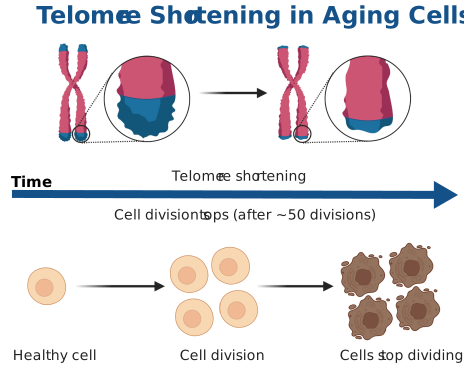
Every time a cell divides, it copies its DNA into the new cells. But the copying machinery can’t quite reach the very end. So each time, the telomeres get a little shorter. After enough divisions, the “caps”, or telomeres, wear down. Once these telomeres wear down to a certain extent, the cell senses that something is wrong and stops dividing for good.
Some cells have a way to rebuild their caps. They use a protein called telomerase. In people, telomerase is mostly turned on in stem cells and in cells that make eggs and sperm. When scientists added telomerase to normal human cells in the lab, the cells blew right past the Hayflick limit.3
Zombie cells
When a cell stops dividing for good, it becomes senescent. (The word comes from Latin for “to grow old.”)
Senescent cells are sometimes called “zombie cells.” They don’t divide, but they don’t die either. Instead, they hang around and leak chemicals that cause inflammation. This can harm healthy cells nearby; you can think of this as one rotten apple spoiling the whole bunch.
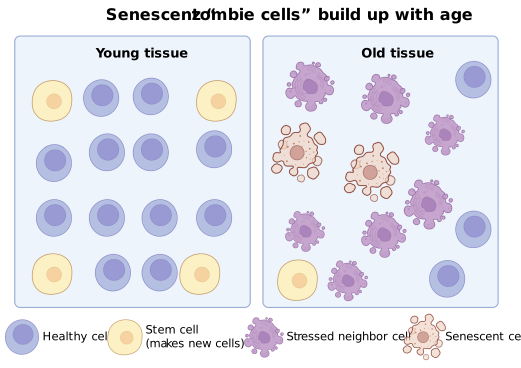
As we age, zombie cells pile up in our bodies. At the same time, our stem cells, the cells that “refill” our tissues, slowly run low. So we end up with two problems: too many damaged cells, and not enough new ones to replace them.
Do zombie cells really matter? In 2016, scientists built mice that could clear out their zombie cells when given a drug. Those mice lived about a quarter longer. Their kidneys and hearts also stayed healthier as they aged.4
So is that why we age?
… Partly. But scientists have found at least 12 things that go wrong as we age. These are called the hallmarks of aging.1 Short telomeres, zombie cells, and worn-out stem cells are three of them. Others include damaged DNA, midfolded proteins (proteins that fold the wrong way), and cell “power plants” (mitochondria) that stop working well.
These hallmarks are all connected. For example, DNA damage can turn a cell into a zombie cell. Zombie cells cause inflammation. And inflammation can damage even more DNA. So aging is a tangled web of factors that influence each other.
We also know telomeres aren’t the whole story. Lab mice have telomeres that are several times longer than ours, and many of their cells make telomerase.5,6 But mice only live about 2 to 3 years!
And many of our own cells, like the neurons in our brain, rarely divide at all. Their telomeres don’t shrink much, but they still age.
Why don’t we just turn telomerase on?
If telomerase helps cells maintain their telomeres while dividing, why doesn’t our body use it everywhere, all the time?
Because cells that divide forever are dangerous. That’s basically what cancer is. In one early study, scientists found telomerase in 90 out of 101 tumor samples, but not in most normal tissues.7
So the Hayflick limit actually protects us. Stopping old, damaged cells from dividing helps keep cancer in check. In a way, senescence is a trade-off. It helps us when we’re young. But zombie cells build up and cause problems later in life.
Are lobsters immortal?
Lobsters have become famous online for being “immortal.”
In 1998, scientists found that lobsters keep telomerase turned on in all their organs, even as adults.8 Lobsters also keep growing their whole lives. So the idea bloomed that lobsters don’t age.
But lobsters definitely die. Lobsters grow by shedding their hard shell, which is called molting. The bigger a lobster gets, the more energy it takes to molt. Some lobsters die from this process. Older lobsters often stop molting altogether. Their old, worn-out shells can then get infected by bacteria, which can kill them.9
So telomerase may help lobster cells keep dividing. But it can’t save a lobster from wear and tear on its whole body.
What about naked mole rats?
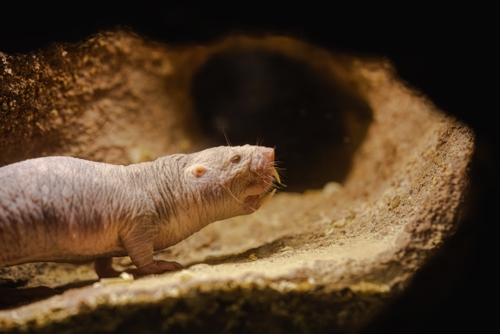
Naked mole rats are wrinkly, nearly hairless rodents from East Africa. They’re about the size of a mouse. But while a mouse lives a few years, naked mole rats can live more than 37 years!10
Even stranger, for most animals, the chance of dying goes up every year as they get older. For naked mole rats, it doesn’t. An older naked mole rat is about as likely to die in a given year as a young adult.10
Naked mole rats do have telomerase. But so do mice, rats, and most other small rodents, and they don’t live nearly as long.6 So telomerase probably isn’t their secret.
Instead, scientists think naked mole rats have several tricks working together:
Cancer protection. Their bodies make lots of an extra-thick, gooey sugar molecule called hyaluronan. It seems to help them resist cancer.11 When Dr. Vera Gorbunova’s team gave mice the naked mole rat version of the gene that makes hyaluronan, the mice had less cancer and inflammation, and lived a little longer.12
Zombie cell destruction. When their cells become senescent, many of those zombie cells self-destruct instead of hanging around.13
Naked mole rats aren’t immortal either. They still get sick and die. But they’re one of the best examples we have of a mammal that ages extremely slowly.
So what does this mean?
Cell loss and senescence are important parts of aging. But they’re two pieces of a much bigger puzzle. Telomerase helps some cells keep dividing, but it can’t make an animal live forever on its own. And in people, it comes with a cancer risk.
Lobsters and naked mole rats show us that there are many ways to slow down aging. Scientists are now studying their tricks to find new ways to help people live longer, healthier lives.

Read More:
- Smithsonian Magazine: Don’t listen to the buzz: lobsters aren’t actually immortal
- Learn.Genetics (University of Utah): Are telomeres the key to aging and cancer?
- Phys.org: Naked mole rats defy the biological law of aging
- The Jackson Laboratory: Cellular senescence and healthy aging
- NobelPrize.org: The 2009 Nobel Prize for discovering how telomeres and telomerase protect chromosomes

Author: Ashley Yeh
When this answer was published in 2026, Ashley was a Ph.D. candidate in the Neuroscience program, working jointly in the laboratories of Julia Kaltschmidt and Christoph Thaiss. Her research explores the gut-brain axis, focusing on how the vagus nerve communicates with the enteric nervous system of the gut. Ashley wrote this answer while participating in the Stanford at The Tech program.